Concourse or Courtyard: Two Ways to Pause Between Play
Concourse or courtyard design shapes shelter, queues and conversation; learn what each space makes easier and how to find a comfortable pause between play.
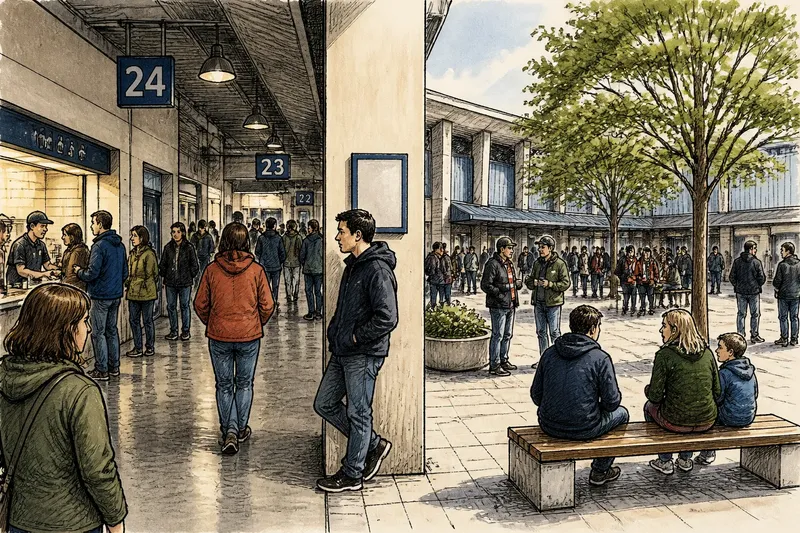
You leave your seat during a break in play and meet a queue, a gust of wind or a crowd moving the opposite way. At a stadium, the concourse or courtyard can make that pause feel sheltered and straightforward—or expose the pinch points between standing, waiting and passing through.
The difference is not simply indoors versus outdoors. An enclosed concourse tends to channel movement beneath a roof, while an open-air gathering area gives people room to spread out but leaves them more exposed. Reading each space by its practical strengths helps you choose where to wait, talk or regroup.
Why does the concourse feel crowded even when it is wide?
A concourse is often a route as well as a destination. People head for food counters, toilets, exits and stairways, so several streams converge. A broad stretch can still feel cramped when a queue occupies the same path as people walking through.
Look for the source of the hold-up before joining the densest knot. Counters and service openings attract stationary groups; corners and stair landings collect people who have stopped to get their bearings. A wall-side area away from those points may offer a calmer place to wait without blocking the flow.
If you are meeting someone, agree on a fixed landmark rather than saying “by the food”. Choose a clearly visible sign, pillar or section marker that is not directly beside a doorway or queue. If you lose sight of each other, move to that landmark rather than walking against the stream.
What makes an open courtyard difficult to use?
An open courtyard can feel easier to cross because people may approach it from several directions and fan out. That freedom can also make the space harder to read: there may be no obvious route, and a group standing in the middle can become an obstacle to everyone else.
Weather changes the character of the pause. Wind can make a conversation difficult; rain can send people quickly towards covered entrances; direct sun may make exposed seating uncomfortable. Check for the courtyard’s sheltered edges, covered arcade or nearby indoor threshold before settling in. The centre may work for meeting briefly, while a protected edge suits a longer wait.
For a short pause, stand where you can see both your intended exit and the people approaching it. Keep bags close and leave a clear route around your group. A courtyard works best when people use its open area to disperse rather than treating every patch of space as a place to stop.
How can you choose a pause that suits the moment?
Start with what you need, not with which space looks more inviting. If you need shelter, a place to queue or a clear route to another part of the ground, the concourse may be more practical. If you want room to talk without standing in a through-route, a courtyard or its quieter edge may suit you better.
- For a quick crossing: stay to one side of the main flow and avoid stopping at doors, stairs or service counters.
- For a conversation: choose a recess, bench or courtyard edge where others can pass without splitting your group.
- For a queue: check whether the line has a marked end and whether it obstructs a route before joining it.
- For shelter: look for an indoor bay or covered perimeter rather than assuming the entire concourse is protected from draughts.
- For a meeting point: use a distinctive fixed landmark, then wait beside it rather than directly in front of it.
Say you have a few minutes before returning to your seat and want to find a friend. If the concourse is backing up around a counter, agree to meet beside a marked section sign just outside the main flow; the expected result is a recognisable rendezvous that does not add another obstruction to the queue.
What should you do when a pause goes wrong?
Why does my group keep getting split up?
Groups often stop where people are already moving, then spread across the route while trying to reconnect. Pick a visible landmark away from a junction, and let anyone who arrives first wait beside it rather than in the middle of the path.
Where can I talk without blocking people?
Move from the main route to a recess, seating edge or courtyard perimeter. If people have to step around you, the spot is functioning as a walkway, even if it looks wide enough to pause.
Why is the courtyard uncomfortable when it looks spacious?
Open space does not necessarily provide shelter from weather or a comfortable place to stand. Try its covered edge or return to an indoor area if conditions make conversation or waiting difficult.
How do I avoid joining the wrong queue?
Find the queue’s starting point and check which counter or service it reaches. If the line is unclear, ask a steward or staff member rather than stopping in a passing route to work it out.
How can you read the space before stopping?
Take a moment to notice how the space is being used. A steady stream through the centre, people bunching near a doorway or a line curling around a counter all show where movement is under pressure. A quiet edge with a bench, clear sightline or covered boundary is more likely to support a settled pause.
Also notice whether the space connects directly to your next destination. A concourse may be the shortest covered route, but a courtyard can offer a clearer route around a queue. Use signs and steward directions to confirm the way, and follow any venue instructions about access or restricted areas.
For the concourse or courtyard question, the useful choice is the space that matches your immediate need: shelter, a clear passage, room to gather or a place to wait. Move out of the through-route, choose a recognisable edge or landmark, and let others pass. That small decision can make the pause easier for your group and for everyone crossing the ground.