When the Turnstile Became Part of the Matchday
Turnstile heritage reveals how a ground organised entry and turned arrival into a matchday ritual; learn what to notice at a surviving entrance.
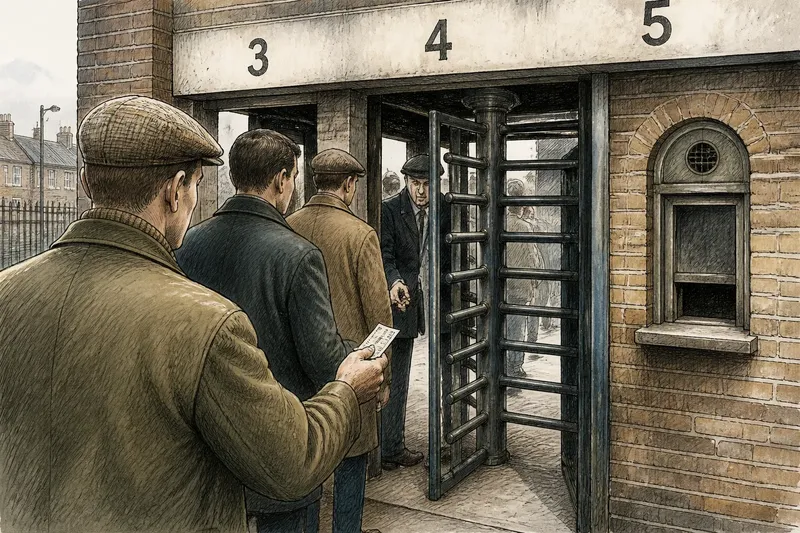
A queue gathers along the pavement, a ticket comes out of a coat pocket, and one supporter at a time passes through a metal turnstile. Turnstile heritage begins at this boundary, where the street gives way to the particular habits and expectations of matchday.
Turnstiles became familiar features at many sporting grounds, though their adoption varied by place and period. Earlier and later entrances could also use gates, doorways and staff-managed checks; the surviving layout, rather than a universal timeline, is the best place to start reading a ground’s history.
How did a turnstile shape the entrance?
A rotating barrier channelled people through a narrow passage and made each crossing distinct from walking along the street. Staff could check admission at that point, while the turnstile gave the entrance a clear physical boundary.
For a spectator, that boundary was more than a line in a wall. The queue, the pause to find a ticket and the brief turn of the barrier marked arrival in a place with its own rules and routines.
Look at how an older entrance directs the body. A narrow approach, fixed barrier or small ticket window may show that admission was arranged as a sequence of movements rather than as passage through an open gap.
How did turnstiles organise arriving crowds?
One-at-a-time passage offered a clear point for staff to check admission. Where several turnstiles stood side by side, separate lanes could divide a larger arrival into smaller streams instead of directing everyone towards one broad gate.
That arrangement shaped the queue. Supporters moved forward in short advances, while a steward or ticket collector could direct them towards a particular lane. The wait became part of the transition from pavement to ground.
Notice whether an entrance retains traces of separate flows: narrow openings, painted numbers or a ticket booth can all offer clues. They do not establish every rule that once applied, but they prompt a useful question: where would a first-time visitor have been expected to join?
What did supporters experience at the barrier?
The turnstile created a brief exchange within a mass arrival. A spectator presented a ticket, waited for the attendant’s signal and pushed the arm around. The repeated movement gave each person a small moment of permission: the boundary opened, and the matchday began inside.
There could also be a moment of uncertainty. A ticket might be tucked away, the queue might slow, or a supporter might need to confirm they had chosen the right entrance. The narrow passage made these small decisions hard to hurry past.
Say you are visiting an unfamiliar ground with a paper ticket marked for a particular section. You compare it with the signs above the entrances, join the matching queue and wait for the attendant’s signal before turning the barrier. The observable result is that you enter the intended part of the ground without having to search for it after crossing.
When viewing a historic entrance, stand where the queue would have started. Ask what a person could see from there: the ticket window, the barrier, a sign, or only the back of the crowd. That viewpoint can make the spectator’s experience clearer than a close photograph of the turnstile alone.
Why do old turnstiles carry heritage value?
A surviving turnstile records one way a ground gave physical form to ticketing and crowd control. Its metal arms, casing and nearby openings may retain marks of use, repairs or changes to the entrance.
Read those traces carefully rather than assuming that restoration should return the entrance to a single, supposedly original appearance. A replacement arm, blocked opening or altered ticket window can record later changes in access and operation. The history may lie as much in those adjustments as in the earliest arrangement.
For a useful field note, separate what you see from what you infer. “Three narrow lanes remain” describes an observation; a claim about how many spectators used them would need further evidence.
How can you read a turnstile on a visit?
Begin outside the entrance rather than treating the barrier as an isolated object. Follow the route from pavement to queue, then note where staff, signs and ticket checks would have fitted. If the turnstile is in use, observe from a safe public area, follow the ground’s access rules and do not touch historic equipment.
- Check the approach: note whether people arrive from one street, a forecourt or several directions. If one route is clearly channelled, follow it to understand the intended queue; if routes converge, record where they meet.
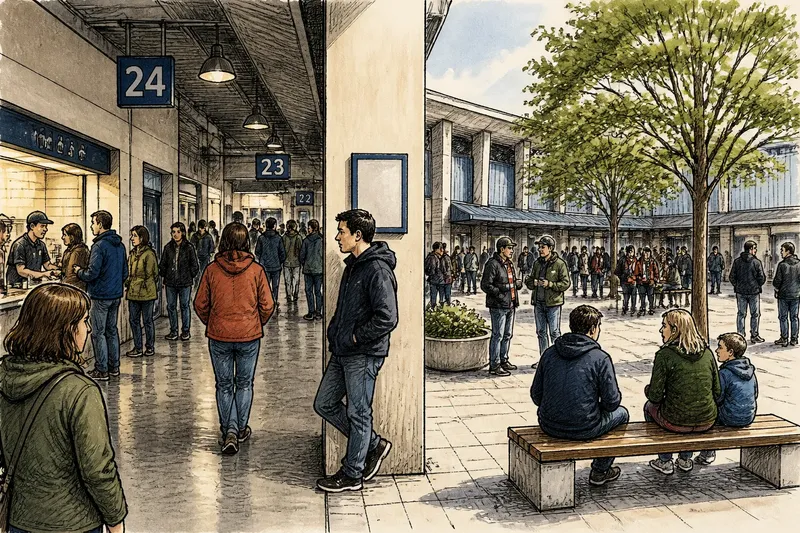
- Check for divided lanes: look for separate openings, numbers or section signs. If they identify different entrances, note which queue each serves; if they do not, describe the openings without assigning a purpose.
- Check the ticket point: locate a booth, hatch or counter and compare it with the queue. If it sits beside the approach, note how a spectator could present a ticket; if it is absent or altered, record that rather than assuming where it stood.
- Check the boundary: identify where public pavement gives way to controlled ground. If a barrier or staffed point marks the change, note its position; if the boundary is unclear, trace the route until signs or access controls appear.
- Check for later alterations: look for blocked openings, replacement parts or changed materials. If a feature appears adapted, distinguish it from surrounding fabric in your notes; if its date or purpose is uncertain, leave the interpretation open.
- Check the spectator’s view: note what someone waiting could see from the queue. If signs or the ticket point are visible, record their position; if they are hidden by the entrance or crowd, note what a visitor might have needed to ask.
Where an entrance has been modernised, compare the old and new routes without assuming that one is inherently better. A wider accessible entrance may serve present-day needs, while a retained turnstile nearby can preserve evidence of an earlier admission system. A useful account describes both the historic arrangement and the route visitors encounter now.
What should you look for when interpreting turnstile heritage?
Why were turnstiles used at sporting grounds?
They channelled admission through controlled points, giving staff a clear place to check tickets and organise arrivals. Their narrow passage also made entry a distinct action rather than simple movement through a gate.
Did every spectator use the same entrance?
Not necessarily. A ground could direct ticket holders towards different gates or sections, and surviving signs or numbering may hint at that division. These clues may reflect later arrangements, so treat them as evidence to investigate rather than a complete record.
What should you photograph at an old turnstile?
Capture the approach, the barrier and their relationship to nearby ticket windows or signs, not only a close-up of the metalwork. A wider view shows how the entrance related to the queue and the ground’s edge.
Can a turnstile matter if it no longer works?
Yes. Even as a preserved object, it can show how spectators crossed from street to ground and how admission was arranged. Its setting and remaining signs often explain more than the mechanism by itself.
What does the matchday threshold still tell us?
Modern entry may use scanners, gates or staffed doors, but the basic encounter remains recognisable: a spectator approaches, presents proof of admission and crosses into the ground. Turnstile heritage gives that sequence a particular physical form, still legible in surviving entrances and remembered in matchday habits.
On your next visit, pause just outside the entrance before joining the flow. Notice where the street ends, how the queue is guided and what signals the moment you are allowed inside; those details can help you read the ground’s history without mistaking a surviving feature for the whole story.